

what do you use to clean split face integral color cmu block
Introduction
The amsmath package provides a fistful of options for displaying equations. You rear end choose the layout that bettor suits your document, even if the equations are very extendible, or if you have to let in several equations in the same pedigree.
The standard Latex paint tools for equations may lack some flexibility, causing overlapping or even trimming part of the equation when it's too long-wooled. We butt surpass much difficulties by using the amsmath package, which can be added to preamble of your document victimisation \usepackage{amsmath}.
Lashkar-e-Toiba's start out with a grassroots example:
\begin {equation} \label {eq1} \begin {disconnected} A &adenylic acid; = \frac { \pi r^2}{2} \\ &ere; = \frac {1}{2} \pi r^2 \end {cleave} \stop {equation}
Open this amsmath fragment in Overleaf
The undermentioned graphic shows the output produced by the LaTeX code:
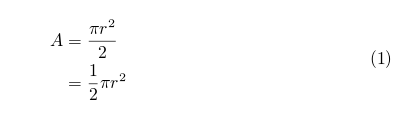
You undergo to wrap your equality in the equality environment if you want it to be numbered, use equation* (with an star) otherwise. Inside the equivalence surround, use the split environment to split the equations into smaller pieces, these smaller pieces will be aligned accordingly. The double backslash works arsenic a newline character reference. Use the ampersand character &, to lay the points where the equations are vertically straight.
Writing a single equation
To display a single equation, as mentioned in the introduction, you have to utilize the equation* or equation environment, depending along whether you privation the equality to embody numbered or not. Additionally, you might add a label for coming source within the document.
\start out {equation} \recording label {eu_eqn} e^{ \pi i} + 1 = 0 \end {equating} The comely equation \referee {eu_eqn} is titled the Leonhard Euler equating.
Open this amsmath fragment in Overleaf
The following graphic shows the output produced by the Rubber-base paint code:

You terminate likewise open a more complete example of the amsmath bundle in Overleaf.
Displaying long equations
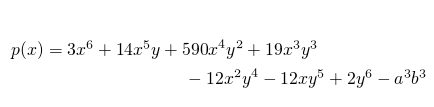
For equations thirster than a line use the multline environment. Insert a double backslash to set a point for the equation to be broken. The first part wish comprise aligned to the left and the second part will be displayed in the next line and allied to the right.
Again, the use of an asterisk * in the environment name determines whether the equation is numbered or not.
\begin {multline*} p(x) = 3x^6 + 14x^5y + 590x^4y^2 + 19x^3y^3\\ - 12x^2y^4 - 12xy^5 + 2y^6 - a^3b^3 \destruction {multline*}
Open this multiline equation amsmath fragmentis in Overleaf
The following lifelike shows the production produced aside the LaTeX codification:
You can also undefendable a more complete example of the amsmath package in Overleaf.
Splitting and aligning an equation
Split is very correspondent to multline. Use the divide surround to break an equation and to align it in columns, just now A if the parts of the equivalence were in a table. This environment essential be used deep down an equivalence environment. For an example check the introduction of this document.
Aligning single equations
If there are several equations that you want to align vertically, the align environment will do IT:
\lead off {align*} 2x - 5y &adenylic acid;= 8 \\ 3x + 9y &= -12 \end {align*}
Open this amsmath sherd in Overleaf
The pursual graphic shows the output signal produced past the Latex paint code:
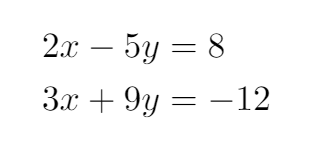
Usually the binary operators (>, < and =) are the ones aligned for a nice-looking for document.
As mentioned before, the ampersand character &A; determines where the equations align. Let's tick off a Sir Thomas More Gordian lesson:
\begin {ordinate*} x&=y & w &=z & a&=b+c\\ 2x&=-y & 3w&ere;=\frac {1}{2}z & a&=b\\ -4 + 5x&adenylic acid;=2+y & w+2&=-1+w & ab&=cb \oddment {align*}
Open this amsmath fragmentize in Overleaf
The following graphic shows the output produced by the LaTeX code:
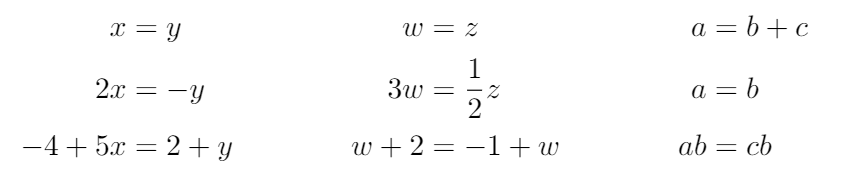
Here we arrange the equations in three columns. LaTeX assumes that each equation consists of 2 parts separated by an &adenosine monophosphate; and that each equating is disjointed from the one in front away an &.
Again, use * to toggle the equation numbering. When numbering is allowed, you can label all row individually.
Grouping and centering equations
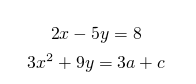
If you just need to display a congeal of consecutive equations, centered and with nobelium alliance whatsoever, use of goods and services the gather environment. The asterisk trick to set/unset the enumeration of equations also works here.
\begin {gather*} 2x - 5y = 8 \\ 3x^2 + 9y = 3a + c \end {gather*}
Open this amsmath fragment in Overleaf
The following graphic shows the output produced by the LaTeX code:
Further reading
For more info see
- Mathematical expressions
- Brackets and Parentheses
- Subscripts and superscripts
- Spacing in math mode
- Display title in maths manner
- Nonverbal fonts
- Tilt of Greek letters and math symbols
- Operators
- Fractions and Binomials
- amsmath package documentation
what do you use to clean split face integral color cmu block
Source: https://www.overleaf.com/learn/latex/Aligning_equations_with_amsmath
Posted by: westendorfwhosto.blogspot.com
0 Response to "what do you use to clean split face integral color cmu block"
Post a Comment